Small Talk Without the Awkwardness
Classroom
Conversation Starters
A Difficult Beginning
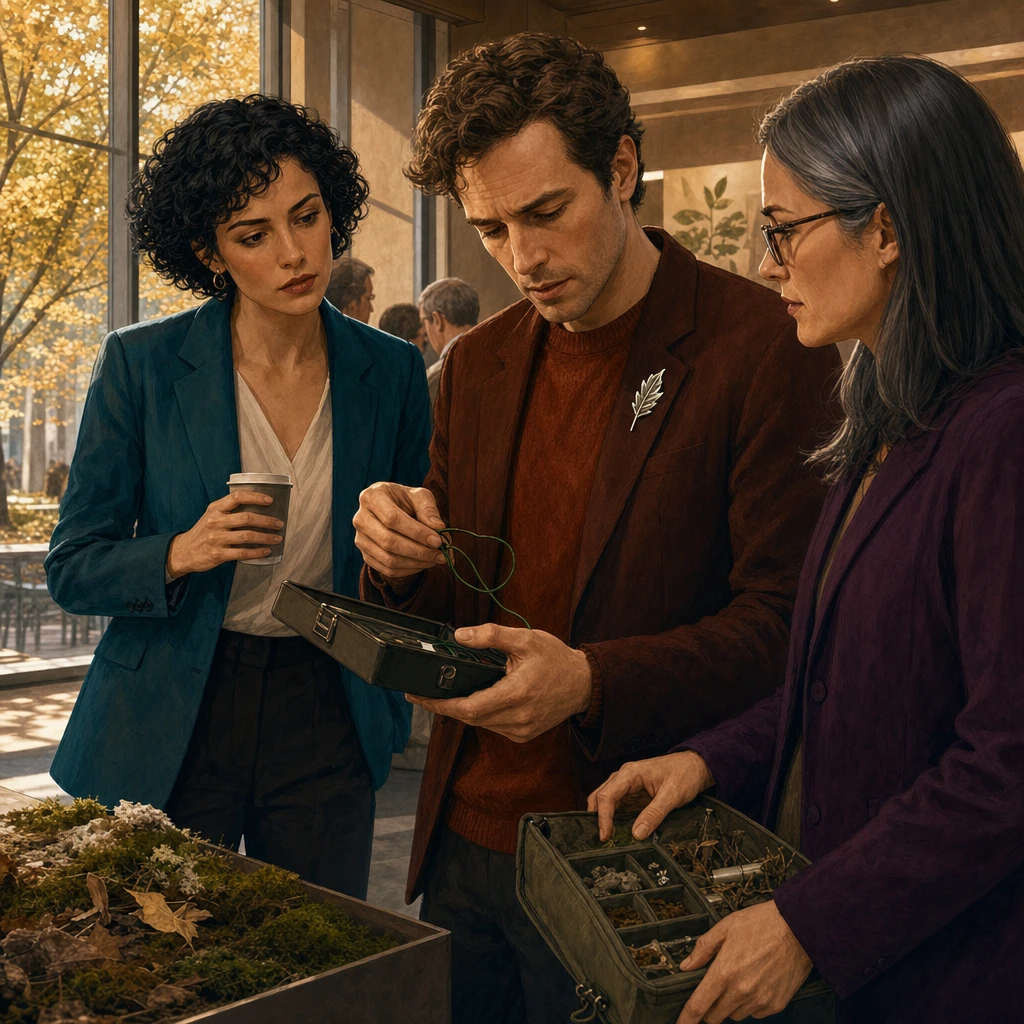
At the Bright Ideas Forum, Mara Venn stood beside a tall window and held a paper cup that smelled of burnt coffee. Around her, designers talked over the soft clatter of spoons and plates. Mara had come to find a partner for her tiny-home project, but every possible opener sounded unnatural in her head. She noticed Theo Arden nearby. He seemed approachable in his rust-colored sweater, and a silver leaf pin shone on his lapel. “Busy morning, isn't it?” Mara said. Theo agreed, and an awkward silence opened between them. Mara stared into her cup, then asked what he did. “I design sensors,” he replied. She almost escaped toward the pastry table, but a green wire sticking from his case caught her attention. “What kind of sensors?” she asked. Theo lifted the case onto the table.
Finding Common Ground
Inside the case lay a PocketSprout prototype, a round sensor designed to help people care for indoor plants. Because Mara designed furniture for small apartments, she immediately saw a connection. “How did you make it small enough?” she asked. This follow-up question changed Theo's posture; he placed both hands on the table and began to elaborate. Mara stayed attentive. She would nod, watch the prototype, and wait through each pause instead of preparing her next sentence. When she wanted to speak, she made sure not to interrupt. Theo explained that his first model had filled an entire shelf. Mara laughed and described a folding desk that had once trapped her inside a cupboard. Their genuine stories revealed common ground: both enjoyed solving problems in limited spaces. The noise of the room faded behind their quick questions and easy laughter.

A Confident Ending
A bell chimed above the doors, announcing Mara's workshop. She needed to excuse herself, but she did not want to disappear suddenly. “I've enjoyed hearing about this,” she said, touching her folded conference card. “I need to get to my workshop, but could we continue later?” Theo smiled and suggested they exchange details. After they did, Mara used his name, wished him luck, and turned toward the hall. Then she noticed Inez Corin examining her furniture sketches near the doorway. Instead of walking past, Mara used a simple opener about Inez's canvas case. She listened to the answer and asked how the plant samples might fit inside folding furniture. When the workshop bell rang again, Mara knew how to wrap up warmly. The three entered together, carrying the PocketSprout prototype between them. On the workshop table, three paper cups stood beside a green plant growing from Mara's smallest folding shelf.

Follow-Up and Indirect Questions
Grammar rule
Use what, how, why, where, or when to ask for more information.
- Direct question: Wh-word + auxiliary + subject + base verb?
- Indirect question: Could you tell me + wh-word + subject + verb? Do not use question word order after the opening phrase.
Use but + reason to end politely: “I'd like to continue, but I need to leave.”
Examples
- How did you make it small enough?
- What kind of sensors do you design?
- Could you tell me how the sensor works?
- I've enjoyed hearing about this, but I need to get to my workshop.
- Could we continue later?
Common mistakes
❌ Could you tell me how does the sensor work?
✅ Could you tell me how the sensor works?
❌ What kind of sensors you design?
✅ What kind of sensors do you design?
❌ I need leave, bye.
✅ I've enjoyed talking, but I need to leave.
